
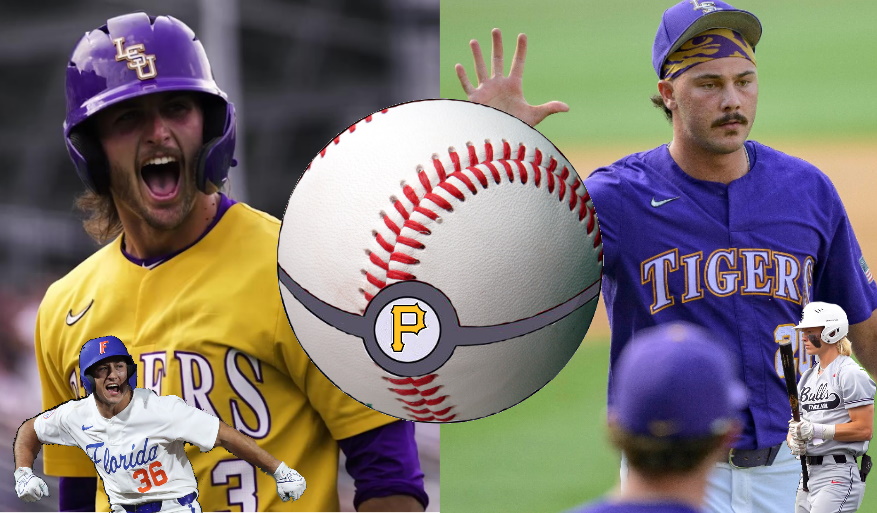
Sunday night is the MLB Amateur Draft, and as some of you may have heard, the Pittsburgh Pirates hold the top overall pick. Now, the MLB draft isn’t QUITE the event the NFL Draft is because baseball players aren’t generally the same level of finished product football players are. Realistically, the guys they’re drafting tomorrow will make their first appearance in the big leagues in 2-4 years. So it’s not quite the same level of immediate help, but it’s still important for a team to get the decision right.
Generally, the two best players in this year’s draft are a pair of college players: outfielder Dylan Crews and pitcher Paul Skenes. They’re teammates at LSU, they just won the College World Series, and were the best hitter and pitcher in the country, respectively. (Crews, in particular, won the Golden Spikes Award, which is college baseball’s equivalent of the MVP.) And they’re both viewed as guys with star potential. Position players are generally a safer bet than pitchers because of the risk of arm injuries, but the Pirates need pitching talent more urgently. So, you’d think this would be a straightforward choice between these two guys, right?
Not necessarily.
The problem is that historically, the Pirates tend to be cheap. Though to be fair, it’s evolved from Just Plain Cheap to Strategically Cheap. In the old days, minor leaguers could ask for whatever sort of money they wanted, so the Pirates would pick a guy who wasn’t going to ask for a lot of money over the guy who was more talented. Bryan Bullington, Daniel Moskos, John Van Benschoten… the list is long and somewhat painful. Since 2012, baseball has introduced a “bonus pool” system that’s not a firm salary cap per player, but caps the TOTAL amount of money teams can spend on their minor leaguers. So there’s SOME degree of cost control because the players and their agents know there isn’t an unlimited bucket of money, but the best guys are still going to try and get every penny they can within that range.
And here’s where the “Strategically Cheap” part comes in. The current system assigns every pick a dollar value, and the total dollar values of a team’s picks represents their total pool of money. But that doesn’t mean the team has to spend it that way. So a team can go “over slot” and pay a guy more than the value his draft position was worth, or can go “under slot” and sign a guy cheaper. And in particular, if you sign a guy under slot, that frees up whatever “extra” money was left over to use on other players.
So the Pirates’ recent strategy has been to go under slot on their first-round pick to save money at the top, and then use that on their picks in later rounds. (What that usually means is using that extra money to convince guys who can still go back to college to give up college eligibility and turn pro now.) They still end up spending all their money, so you can’t really accuse them of cheapness in the same way they used to be, but they do tend to be reluctant to pony up for the star player and prefer to spread their money around.
The 2021 draft was a textbook example of this. Henry Davis, a college catcher from Louisville, was not particularly viewed as the best player in the draft. But they were able to get him for about $2M less than his slot, which let them throw extra money at a college lefty (Anthony Solometo) and two high schoolers who had first-round talent but were considering college football scholarships (OF Lonnie White and pitcher Bubba Chandler). Chandler is struggling at A-ball, but the other two guys are doing OK.
To be fair, in 2022 when they picked 4th overall, they actually went about $200k over slot on their first-round pick Termarr Johnson. So it’s not like they’ve NEVER gone over slot. But they do seem to like to spread the risk around.
So that brings us back to Crews and Skenes. The Pirates have about $16M total in their bonus pool, and pick 1-1 is valued at $9.7M. According to the rumor mill, Crews is almost definitely going to ask for above slot (among other things, he’s repped by agent Scott Boras, who tends to negotiate aggressively). Skenes may have to take a discount for the risk associated with pitchers, but nobody sees him signing for much less than slot.
So that’s where Wyatt Langford and Max Clark come into the picture.
Langford, who played left field for the University of Florida, is viewed as the next-best college player, and in a different year might be the frontrunner for the top pick. And you can find a minority of people who think he’s even better than Crews. He actually hit for more power than Crews (28 doubles, 21 homers vs. 16 and 18 for Crews, and that’s with 10 fewer games); Crews just did everything else better — faster, better defense at a tougher position, better overall contact and plate discipline.
Clark is a high school outfielder. Now, high schoolers inherently represent a bigger risk because you’re talking about taking a 17/18-year-old kid and guessing how he’s gonna play when he’s done growing, whereas college guys are closer to finished products physically and just need to improve on the craft of the game. But some people think Max Clark’s physical tools are good enough that he could be better than either Crews OR Langford. IF he pans out, which is admittedly a huge if.
So it’s really a question of Crews at a price over $10M, Skenes probably somewhere around 9 or 9.5, or maybe see if you can sneak Langford or Clark in at $7-8M and hope the LSU guys don’t make you look stupid for doing so.
So where do I think this all lands?
I’ll start by eliminating Clark. There’s been some scuttlebutt that the Pirates are seriously considering him, but even if you want position player over pitcher, I just don’t see it being worth the risk when you have two more refined college bats on the table. (Though if one wants to briefly make the case, it’s that you could get Corbin Carroll-type speed even if his power never develops, and if his power DOES develop, you’ve got a true five-tool guy.)
A month ago, I would’ve thought the Pirates would try to work the angles and gone with Langford. Play up the fact that he hit for more power than Crews and an almost identical OPS, drop some reminders in friendly press ears that Crews’ 2022 season wasn’t nearly as remarkable… it’s a defensible pick and maybe you save an extra million or two for other guys.
But the Pirates’ pitching woes since their hot start in April now have me thinking they’re going to open up the wallet for Skenes. They already lost J.T. Brubaker for the year in spring training. Luis Ortiz and Roansy Contreras have both slid backwards; Contreras is trying to sort himself out in the pen and Ortiz just got sent to AAA. Quinn Priester, the current top pitching prospect in the organization, is in AAA, but is holding his own more than knocking down the door (though to be fair, you can make a case he’s young for the level). Right now, it’s basically Mitch Keller, 43-year-old Rich Hill, and the power of prayer. (And as a cascading effect, the bullpen has been a hot mess, so they could use some starters who can work some quality innings and take pressure off the bullpen.)
To be clear, I don’t think any of these guys represent a horrible misstep. Not even Clark, though I feel like that might be too big a roll of the dice. But I keep coming back to this: if Langford and Crews are 1 and 1A, there’s NO pitcher in this draft… or even the last few drafts… who compares to Skenes. He throws triple-digits without exceptional effort and decent control, and his secondary offerings look pretty close to major-league ready. There’s legit staff ace potential here.
But that’s just the opinion of one fan. Check back in 36 hours or so to see what the guys who actually make the decision think, because that’s the opinion that matters.

 Mental Zoomies